Google+ has been available for about three months to those with invites now, and Google claims to have made 100 improvements to the service during that period – quite a feat. But now Google+ is getting ready for the bigtime with it hitting a Beta release (and remember GMail was beta for years).
Along with the beta release, Google+ gets a search function (I know!), as well as various features for Hangouts – the relaxed multi-person video chat service. They’ve added Hangout support as an Android app with iOS support on the way, but even more interesting is the ability to go “on air”. Using this people can still chat with up to nine others involved, but with the ability for anyone to watch passively. This has great applications for interactive livestreaming – where a live debate between people at different locations can be broadcast to an audience across the globe. It’s social application may be more limited, but it sounds a fantastic tool for education and discussion. They’ve also released an API for Hangouts for other services to make use of its functionality – something I see many doing for their on air service.
These improvements have also coincided with Google+ being opened up to the world at large, with no need for an invite anymore – it sounds like Google thinks it has done the stress-testing, and are ready to take on Facebook, Twitter, Linked.In and even Microsoft/Skype with the service.
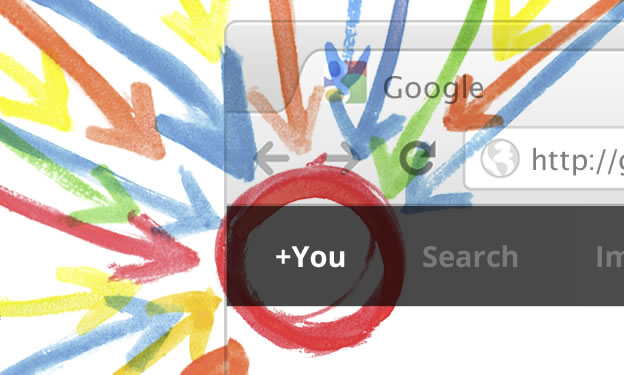
And to publicise the opening of its doors, they’ve made a rather simple but effective ad on the Google.com homepage of a big arrow pointing up to the information bar at the top containing the service.
We’ve seen video chat making a charge to social over the past week with Facebook and Skype joining forces to offer easier video chat with your Facebook friends, and Google+ introducing Hangouts for group video chatting.
The Skype + Facebook deal is an interesting one with Skype now owned by Microsoft, and the company pushing for even deeper penetration into people’s phone habits – you can Skype from your mobile (for free on some networks like 3), and video chat between two people is free as it always has been. Skype is the company that brought video calling to the masses, and as such is by far the biggest player – but it is a freemium product, so calling out in most countries costs a small amount, and to group video chat you need at least one user to be a Premium Subscriber.
This is where the two services differ – Google’s Hangouts is a completely free service with no premium upgrades available, and whilst group chat on Skype is a value added service, group chat on Hangouts is the main service. Google+ has made it ever so simple to send out invites to the people you want to chat with, and then focusing the video on the person doing the talking at the time. What hangouts is less good at, however, is the one to one video chat that Skype excels at – sending an invite to chat with one person is annoying when you just want to ring them, and finding that person on Facebook is about as easy as it gets.
Both services, then, have their own strengths and weaknesses with little overlap in reality. Both products require downloads – and currently if you want the best of both worlds you’ll need both. With Microsoft pushing for deeper market penetration you can expect that Skype may well make video calling free for friends (something Facebook could be used to discover), whilst leaving it as a premium service to businesses – whilst at the same time Google is only going to make it easier and easier to make person-to-person calls from Google Hangouts.
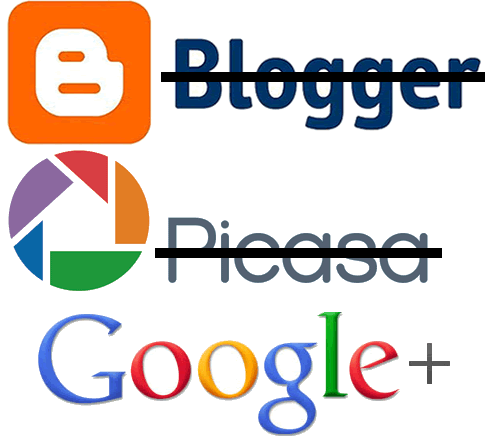
Google is set to rebrand Blogger as Google Blogs and Picasa as Google Photos in an upcoming shuffle of the company to align with the launch of Google+ according to a story in Mashable today.
Google has operated Blogger since 2003 and Picasa since 2004, with both becoming well-known brands and Blogger being one of the top ten most visited sites in the world. However with an aim to unify branding across the Google network, it appears that both will be receiving new name amongst other changes to truly all become part of the same Google+ service. Blogger is also rumoured to be completing a massive redesign and Picasa may become offer unlimited photo storage in the overhaul.
Youtube will not be rebranded as the Google Video name has been tarnished with Google’s prior failed video service and Youtube is a household name, although it may well still receive some of the Google+ integrations alongside Google Music.
The overhaul is rumoured to take place before Google+ is opened to the public on July 31st
Google has had access to Twitter‘s real-time “firehose” since they came to an agreement for an undisclosed sum back in October 2009. It has allowed the search giant to keep its search results looking fresh and up-to-date as well as power Google Realtime. But this deal expired on July 2nd and has not been renewed.
The reason for letting the agreement expire has not been disclosed by either party – it may be due to price or Google moving to focus more on its own Google+ social updates offering. However, even without the agreement Google will still index a great number of tweets as each tweet is in effect its own web-page – the indexing will just not be in realtime as offered by access to the firehose.
Google may have only released Google+ a couple of days ago, but it has already become a popular way for the limited invitees to interact and share media. With that in mind Google has already released the Google+ App for Android with an iOS version waiting for Apple App Store approval, and a pretty decent HTML5 app as well.
The app gives you easy access to your profile, your stream of recommended media and links via Sparks, your Circles for controlling who sees what you share, and Huddle the cross-platform group-messaging tool, and Photos for sharing your pics privately through Picasa. It has a great easy to use interface, something Google has previously struggled with, and gives you more control over your sharing of information compared to rival Facebook.
Available on: Invite only on Android | HTML5 | iOS (soon)
We’ve been hearing rumours of a Google social network for months as it tries to take on the likes of Facebook and Twitter that are increasingly dominating how people spend their time online, and finally they’ve delivered.
Google+ is not a social network by traditional terms along the lines of Facebook or MySpace, but more a collection of services that all offer social aspects – ways to interact with others through them. It is not, then, a place to find new “friends” (a la Facebook) or even followers (a la Twitter), but a place to interact with your current friends – those with which you want to share and interact without it being on view for the whole world. Yes you have a profile as on any other network and you can share your +1s, photos, links,and videos just like other social networks, but that is really incidental to Google+ as it stands.
Alongside the +1 and other sharing buttons that have appeared across various sites (including this one) over the last month, Google has introduced a number of new tools which I’ll describe below:
Circles
Circles is the central cog of Google+ as it is the place where you organise your friends into groups/lists known as “circles”. You import your contacts from GMail and drag and drop them into groups depending on your relationship with them, or your shared interests, or any other link you fancy. The aim is to keep your feed uncluttered and leave you free to see what your friends are up to that you are actually interested in rather than that constant overflow in Facebook and Twitter where everyone you know is treated relatively similarly in your feeds. Yes you have to create these lists, with Google not using some algorithm to do so – but this means you won’t be sharing that blue video with you boss by accident.
Sparks
Sparks is the Google+ recommendation engine – where you tell it your interests and it will automatically present yo with content (articles, blog posts, videos, etc) in that field – with that content recommended by how often people are hitting those +1 buttons.
Hangouts
If you hit the hangout button then all your friends will see that you are available online and ready for an informal video chat. Most video chat is done with a specific purpose in mind and scheduled for a specific times these days – but Google is trying to change that. It’s different to the “I’m Online” link in Skype as the invitation here is an open one, and anyone can join in the chat even once you’ve began to speak to someone. It may get ignored by people, but it is an open invitation to interact casually via video – something people are yet to really do.
Huddle
Group messaging is nothing new with BBM on Blackberry, iMessages on iOS, Beluga and a number of independent entries into the market – but no-one has yet dominated this field across devices. If you’ve already organised your friends into circles, then contacting just the right people should be pretty simple with Huddle which could give it a leg-up against current offerings.
Google+ will be available online (obviously), but also through a desktop app and on both iOS and Android. If it’s done right this could be the middle ground between over-sharing on Facebook because all your acquaintances are treated as friends and the under-sharing on Twitter because it is so very public – the real sharing for your real friends. And with Andy Hertzfeld, a member of the original Mac UI development team, on board – this thing actually looks good, something Google has traditionally not been so great at.